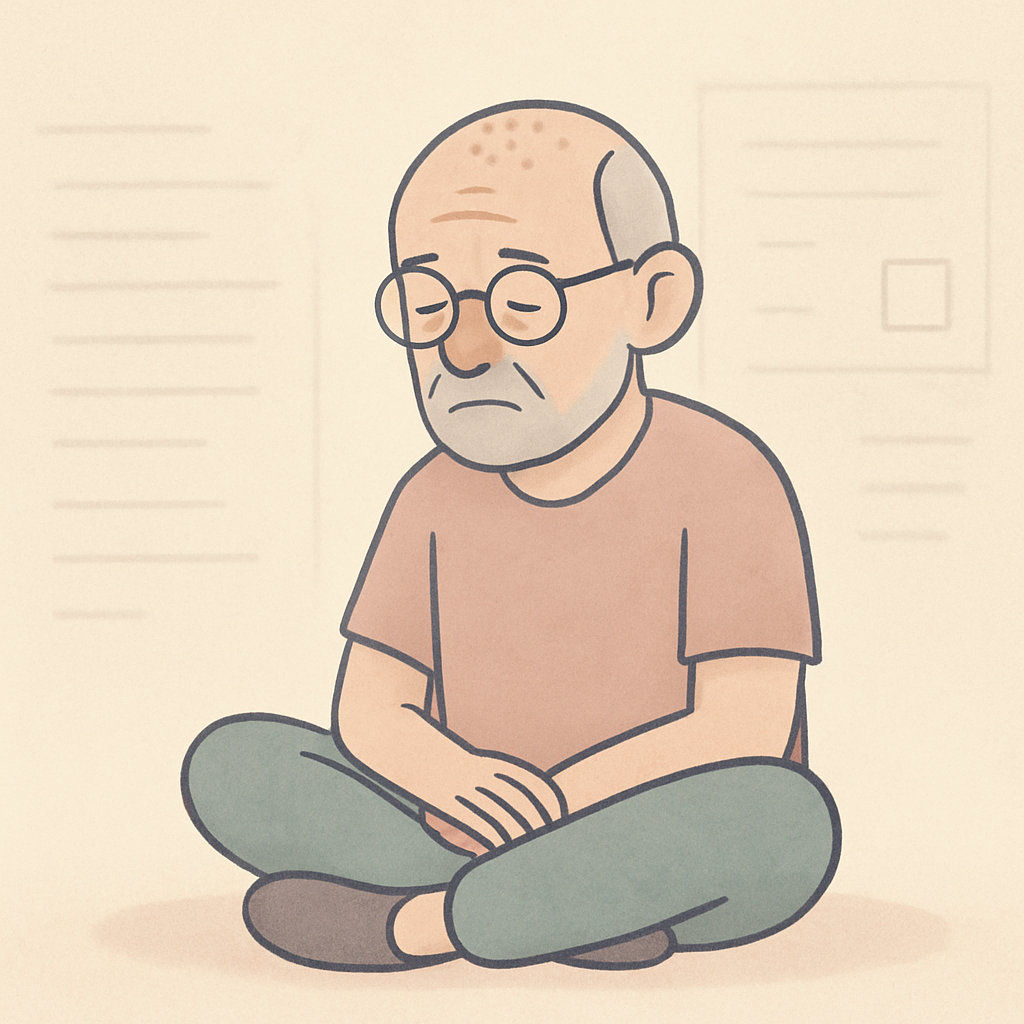
On care that stops, and the quiet harm it allows
In my case, the tipping point came during a team meeting, one of too many, where a colleague gently suggested creating a program to help improve recruitment and retention of staff who are blind or have low vision. The response was a chuckle. Meant to be a shared chuckle based on shared history and experiences. And it was capped by the manager’s line: “We can try, ha ha ha… but we all know how that kind of thing goes.” Maybe for some, the laughter was a coping mechanism. But for me, it was the moment I stopped finding it funny. I’d seen too many examples of that same dismissiveness dressed as realism. I melted down. Quietly, inwardly, but completely. I became non-functional at work. What followed was over a year of enforced mental health leave. At the time I had an ADHD diagnosis. Later, I received a formal assessment confirming Autism Spectrum Disorder (Level 2). This was a diagnosis that reframed everything for me. But no one ever asked what might have led up to that breakdown. Not the employer. Not the external psychiatrists. Not the process itself. Instead, I was subjected to flawed fitness-for-duty assessments, including one that suggested a personality disorder after a short box-ticking session. I ran out of leave. I was told there was no compensation. I sought redress from HR, from external bodies, from the union. Each path ended with a variation of “we’ve met all requirements.” And the role I’d held, that of supporting assistive tech users across the organisation remained unfilled. The harm wasn’t just personal. It was structural, systemic, and shared.
“This situation represents a form of structural violence, where institutional policies around psychiatric assessment and return-to-work fitness created avoidable harm through procedural adherence. The harm, economic, psychological, and social, was not the result of individual malice, but of a systemic rigidity that denied agency, erased context, and failed to recognise legitimate neurodivergent needs.”
In hindsight, what I experienced was likely autistic burnout, which is the result of long-term mismatch, exhaustion, and system-induced overwhelm. It wasn’t a collapse in the psychiatric sense, though it may have looked like one. It was a shutdown that needed understanding and space to recover. What it got was suspicion, restriction, and bureaucratic coldness.
And that harm didn’t just affect me. I work in assistive technology, specifically supporting users of Dragon speech recognition in complex workplace environments. It’s specialised work. Quiet work. And it’s needed. During the enforced absence, people across the organisation who relied on that support didn’t get it. Not because I wasn’t willing or able, but because I wasn’t permitted to return.
They couldn’t replace me because this kind of work isn’t easily substituted. You can’t hire someone off a panel and expect them to replicate decades of direct experience, communication insight, and hard-won trust with users. So the harm rippled outward. The absence became systemic.
And that’s what makes this story worth telling. Not because I’m stuck in it, but because I’m past it. What I’m offering here is a case study. A working example of how even well-meaning systems can quietly cause harm, and how that harm expands through quietly compliant indifference.
Bureaucratic Numb Spots
In my experience, bureaucracies have what I’d call numb spots. These are zones where the caring stops. This is not because people don’t care, but because the system doesn’t ask them to.
I’ve seen and received real compassion when needs align neatly with policy. But when they don’t, when something falls outside the framework, the shift is immediate. Warmth gives way to coldness. Not hostility, just absence.
One day you’re being helped. The next, you’re an anomaly.
A Procedural Anomaly
I walked the full path of formal complaints, external agencies, internal reviews, union advice. And again and again, I heard the same thing:
“That does sound like a real grievance… but it’s not something we can do anything about.”
No escalation. No remedy. No code. No box.
That was the end of it.
And what isn’t logged, can’t be seen.
What isn’t seen, won’t be fixed.
Structural Violence in Plain Sight
“Bureaucracy is not good or evil. But it can be either.
It is a tool for care, or for indifference or even cruelty.
What it becomes depends entirely on what it is permitted to notice.”
This was a textbook case of structural violence: no single bad actor, no smoking gun—just a system that failed, passively but completely, to care about something it wasn’t designed to see.
And that’s the point of writing this. Not to relive the harm, but to understand how it happened and hopefully help others see it too.
The Role of Policy
Here’s where we go wrong.
We treat policy like scripture. Like policy itself is unchanging, authoritative, unquestionable. But policy is not law. It is not an endpoint. A good policy is a guide, not a gate. It exists to help a system adapt and respond. Hopefully again, not to give it permission to turn away.
When policy becomes rigid and is used to justify inaction instead of support I would argue it reshapes the culture. Not all at once, but slowly, procedurally, thoroughly.
And it doesn’t take much to change that.
A Commitment to the Spirit of Policy
We don’t need social engineering.
We don’t need a thousand new committees.
We just need a shared commitment to the idea that policy is a tool to care for people, not protect systems from them.
Here’s what that might look like:
I just want to say first , many important policies exist for a reason. An organisation must be able to define its direction, state its boundaries, and set consistent expectations for both staff and leadership. A good policy shows people the way forward, it’s a structure, not a sentiment. Nothing here is intended to undermine that. What I’m pointing to is a gap: when something arises that falls just outside that structure, and the only available response is: “Sorry, there’s nothing we can do.” What if that response wasn’t the end of the conversation? What if there was an agreed mechanism, a values-driven pathway, to deal with outliers constructively and fairly?
We believe that policy exists to provide clarity, direction, and consistency, both for those who lead and those who serve. It is a tool for guiding care, not limiting it. We commit to interpreting policy in the spirit of service, to understanding its purpose, applying it with flexibility where appropriate, and responding with humanity. Where policy is silent or gaps are exposed, we will not treat that silence as final. We will treat it as a prompt to listen, to review, and to ask whether something important is being missed. Where possible, we will seek structured ways to assess such situations, learn from them, and adapt. We are here to support people, not just procedures.
What this looks like in practice will depend on the organisation’s will and capacity. It may involve an internal review process for exceptional cases. It may include an independent assessment body to examine whether someone has fallen through a procedural gap, and if so, whether redress, recognition, or systemic adjustment is warranted.
The point is not to promise resolution in every case. The point is to promise attention. To make space for the possibility that something important may be happening outside the checklist and that in those moments, we look.
Because when systems stop looking, they stop caring. And when they stop caring, they stop serving.
☕ If you’ve found something here that resonates, you can support my work:

Pingback: Dispatch Five: Masking – All the Adjustments are Mine – Patrick Morris
Pingback: Dispatch Six – The Illusion of Fairness – Patrick Morris
Pingback: Dispatch Seven: The Measure of Success – Patrick Morris