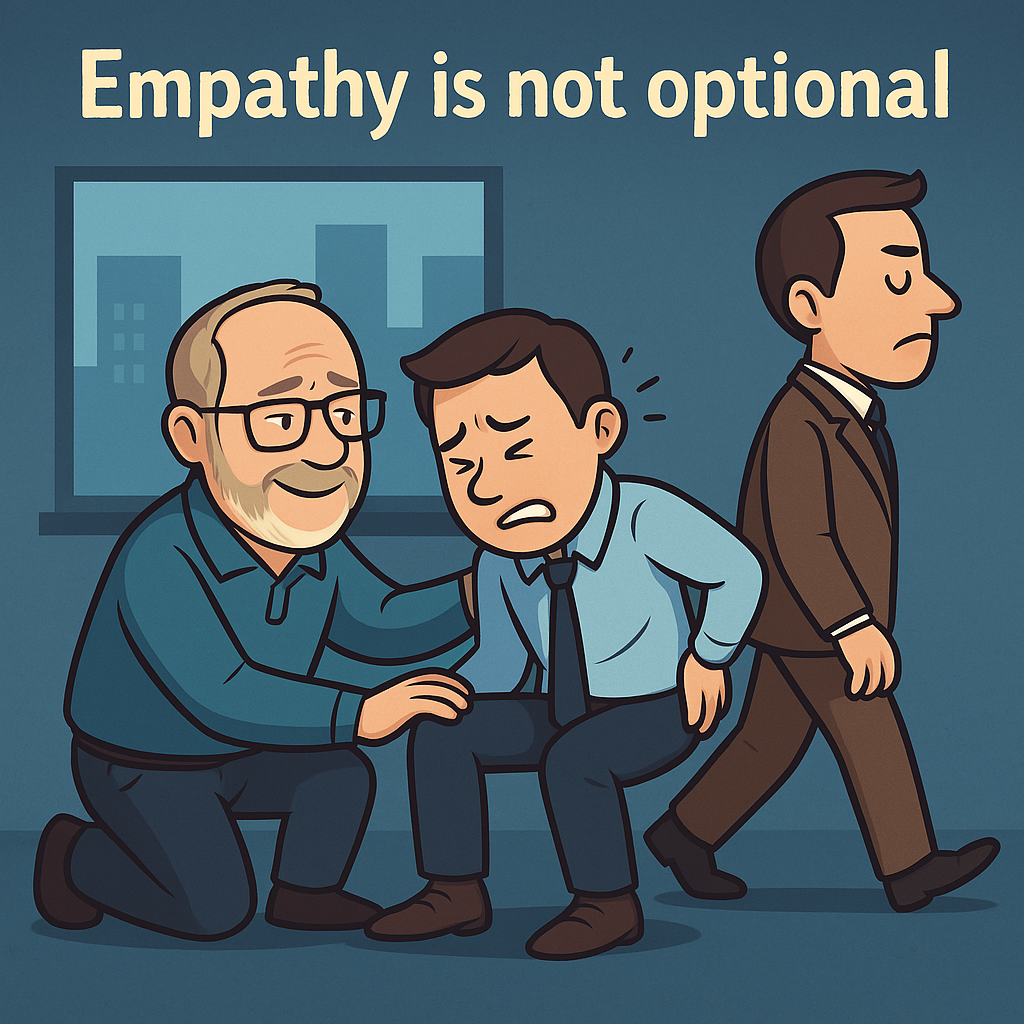
For me, empathy is not an optional trait. It is not a soft skill, and it is not a negotiable ideal. Empathy is the foundation of a civilised society. It is the mechanism by which harm is minimised, understanding is made possible, and dignity is preserved. Without it, we do not function as a community. We devolve into systems of power, exploitation, and cruelty.
Empathy allows us to care about others not because they are like us, but because they are real. As real as we are. As valid, as whole, and as human.
This is not sentimentality. This is structure. When someone lacks empathy, they may be difficult to trust. But when someone actively despises empathy, when they treat it as weakness or foolishness or as an obstacle to ‘winning’, they have crossed a moral boundary. In my ethical framework, that person becomes, for lack of a better word, dangerous. Not in a religious sense. In the clearest human sense. They have chosen to reject the shared humanity that binds us together.
It is not just the absence of empathy that disturbs me. It is the hatred of it. Because that hatred is not neutral. It is a declaration that the suffering of others is irrelevant. That the idea of being moved by someone else’s pain is laughable. That dominance, efficiency, and self-interest are more important than compassion. And that is a dangerous position for any human being to hold. Especially one with influence, leadership, or a platform.
When I hear public figures deride empathy as a flaw or a threat, I do not hear strength. I hear pathology. I hear someone who cannot be trusted with power, because they cannot acknowledge the moral weight of their impact. Empathy is not a liability in civilisation. It is civilisation. Without it, we are nothing but noise and force.
This links back to the fog I spoke of in Dispatch One. The fog has names. Names like soft, weak, woke, naive, bleeding heart, snowflake. Names that are hurled at people who lead with care instead of power. At people who pause, who listen, who imagine someone else’s pain. Those names are not just insults. They are an attack on the idea that decency matters.
Empathy asks us to look again. To wait. To hear what was not said loudly. It demands that we see others not as problems to be solved, but as people to be understood.
This series, Dispatches from the Edge, continues because I believe the moral line is real. And it runs straight through the centre of empathy. Cross it, and something vital is lost. Hold it, and something human remains.
☕ If you’ve found something here that resonates, you can support my work:

Pingback: Dispatch Six – The Illusion of Fairness – Patrick Morris