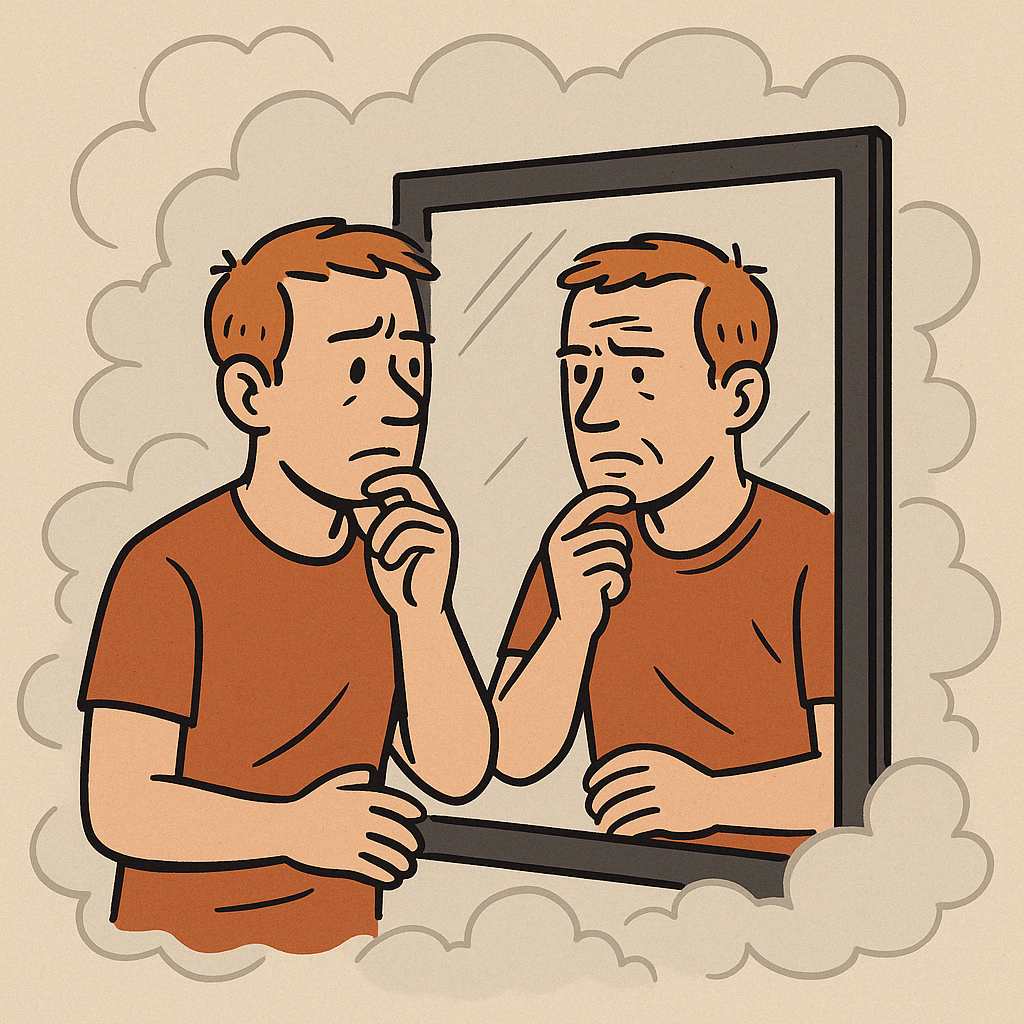
Empathy may be the foundation of civilisation, but observation might be the first tool we ever used to make sense of it. Not the loud, assertive kind of observation that imposes itself on others, but the quiet kind. The kind that watches patterns unfold over time, notices familiar stumbles, sees how fog gathers before we even name it.
This kind of observation doesn’t demand change. It invites it.
For many of us living with neurodivergence, life often feels like an endlessly recurring mystery novel, except we already know the ending and it’s never quite satisfying. We try harder, we push through, we look for a better routine, a sharper strategy, a cleaner inbox. And when things still fall apart, we blame ourselves. We assume that because the world feels difficult, we must be doing it wrong.
But there’s a point where the effort itself becomes unsustainable. Where pushing harder stops being noble and starts becoming noise. And if we’re lucky or tired enough we stop. And in that pause, we begin to see.
What we see are not failures. We see friction. Predictable resistance. Recurring overwhelms. The same sensory shutdowns. The same mornings that fall apart in the same way. Not because we’re lazy or broken or unmotivated, but because the system we’re using doesn’t account for our wiring.
Observation, in this context, becomes a survival strategy. It’s how we begin to collect data, the internal, unspoken kind. The kind that notices, “I always crash around 3 p.m.” or “I dread the train, even when it’s quiet.” These are not quirks. They are signals.
And like any good signal, once noticed, they start to change how we navigate.
I sometimes call this the Friction Insight Model, but I’m not precious about the name. It’s not a clinical tool, and it’s not meant to be neat. It’s more like a personal language of pattern recognition. You start seeing the same invisible tripwires again and again, and over time, you learn where not to step.
It’s not therapy or productivity hacking. It’s closer to cartography. You’re just drawing a better more detailed map of your life; one made from real terrain instead of wishful thinking.
There’s a strange magic in this. Because when you begin to observe with compassion, rather than judgment, things change. The same way a quantum particle behaves differently when observed (yes, I know it’s more complicated than that—but indulge the metaphor), your behaviours begin to shift when you see them clearly and kindly.
That’s the Observer Effect, applied inwardly.
It doesn’t fix everything. But it does create space. And you can use that space for forgiveness or for adjusting course. And also, space for saying no to the overnight trip and yes to the quiet afternoon. Space to stop screaming at yourself for sweating on the train and start packing a better hat.
And in that space, something better than effort often appears. I would call it clarity. And with it, the faint but steady return of agency. A sense of agency at the very least.
For years, I thought I needed discipline. I needed data. My own data. The kind only I could gather by paying attention in a receptive state. I didn’t need a better attitude. I needed to understand unambiguously where to step, I needed a better map.
This isn’t self-improvement. It’s self-witnessing. And for a lot of us, that might be the most powerful change of all.
Especially when the world doesn’t make space for us to be seen.
This might be the quiet truth and once you can see it, you can name it. And once you can name it, you can navigate it.
The fog still comes. But at least now I have a sailor’s chance of navigating a safe passage
☕ If you’ve found something here that resonates, you can support my work:
