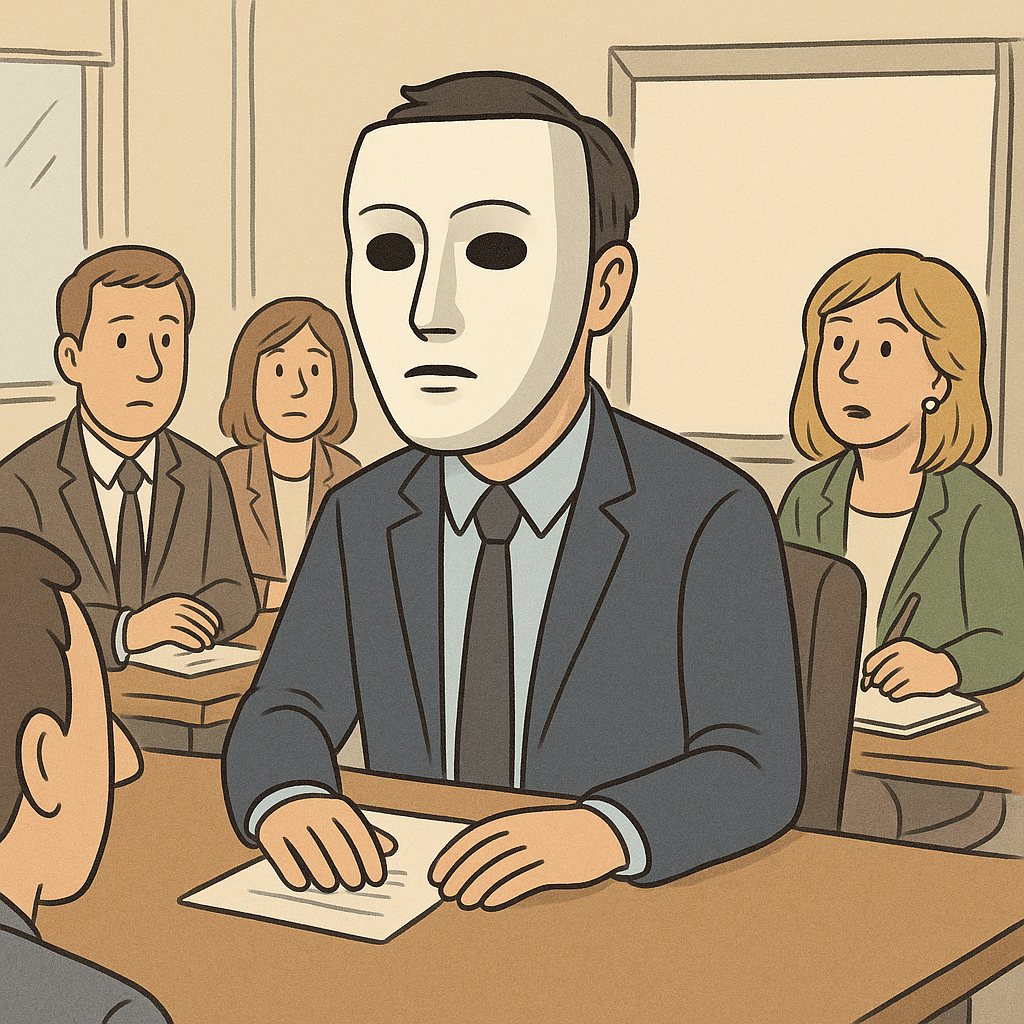
For neurodiverse people, masking can take a number of different forms and can be used for different reasons. It isn’t unique to autism. It’s also common in ADHD and likely used by people with many other diverse conditions.
I’d like to draw out some examples of masking from my own experience and explore the experiences of others. This is about establishing the fact, if it is a fact, that masking is an adjustment made entirely by the individual to accommodate the world they encounter.
I also want to highlight the complexity of masking. Just as masking acts as a filter between yourself and the outside world, it can also serve as an internal filter. You can mask to others without knowing, and you can mask to yourself without knowing. This is one of the reasons why navigating social situations, especially the dry reality of workplaces, cannot be left to the individual alone.
Dispatch Four discussed a workplace incident involving myself. In a team meeting, I melted down inwardly but appeared calm and collected on the outside. Outwardly, I remained functional. I didn’t shout or complain. I didn’t stomp out or break down visibly.
If you missed Dispatch Four, you can read it here.
Inwardly, I experienced a complete emotional, cognitive, and functional shutdown. All of it was invisible, because I was masking. I filtered my responses, presented a neutral and professional persona, and carefully removed all visible signs of distress while internally I was deteriorating rapidly.
Why was I masking in that situation? That’s a difficult question. I was a man in my 50s who, for most of that time, didn’t know he was autistic or had ADHD. That kind of behaviour had become automatic and deeply entrenched. It was a survival skill. I didn’t want to stand out. I wanted to meet expectations and avoid being labelled difficult. People who get emotional at work are often diminished afterward. The goal is to be seen as a seamless part of the social fabric.
That meeting was a major turning point. But the pattern repeats every day to varying degrees. Autistic masking is often about enduring internal pain in order to preserve stable social interactions. It’s not deceitful in a moral sense but a reflex, developed over decades of conditioning. For many autistic people, the world is simply too loud, too bright, too unpredictable.
If you imagine that underlying layer of constant endurance, then picture a significant event landing on top of it, you start to see why seemingly “out of nowhere” meltdowns happen. In reality, those so-called explosions are often the final stage of autistic social fatigue.
Masking for ADHD is a different experience, driven by different motivations. For example, I worked for decades supporting people using assistive technology in the workplace, a function carried out within a long-running bureaucracy. In my experience, bureaucracies don’t do caring very well. So, when you find yourself in an isolated caring function, like supporting people with disability or injury, you never quite feel part of the system.
Outwardly, I was respected. I was the reliable specialist with deep knowledge, known for navigating complex user needs and bureaucratic red tape. And truthfully, the work suited my ADHD. I had endless rabbit holes I could follow. I loved puzzling through assistive technology issues, because they brought together all my skills and interests.
My pattern recognition became highly tuned. People could begin describing a problem, and before they’d finished their sentence I’d already run through multiple probable causes and started ruling things out. I created a model of service that didn’t exist before, certainly not in the public service, and probably not in the private sector either.
It wasn’t strategic. It just worked. It served an identifiable group of people: many with disability, many with injury (often meeting the definition of disability, at least temporarily) who consistently struggled in the same areas over decades.
Because the people I supported were happy with my support and training, there were no complaints or issues about my part in their work life. That is a fact. And because I was perceived as high functioning, I was never given additional resources. I tracked everything in an Excel spreadsheet. I used only email. No formal system. And it worked for 24 years.
Until it didn’t.
That didn’t mean I wasn’t struggling. I was. Constantly. If a system issue affected all assistive tech users, I was the highest point of escalation and managing those issues without support was difficult. Even now, resolving a single ticket across three different windows can be too much. I’d double down and write longer notes, set more reminders, all while feeling less and less connected.
I was terrified that if people saw how much I struggled, they’d think something was wrong with me. The last thing you want to be in a bureaucracy is “difficult.” The entire point of masking is to try to look like everyone else, or at least your idea of what “everyone else” looks like.
So, what happens when both autism and ADHD are involved?
This is just one lens. My specific story isn’t unique. People with other neurodivergent profiles or different backgrounds may experience similar things. It’s a matter of degrees. Everyone masks to some extent. The real question is: how much impact is it having?
After my breakdown, I interacted with HR, external psychiatrists, and other bureaucratic bodies.
Outwardly, I came across as articulate and educated. High functioning. The kind of person who can hold a professional conversation with a psychiatrist or HR rep. But beneath that, I might have been a quivering mass, wanting nothing more than to run.
Internally, I was trying to suppress sensory overload and the discomfort of social distance. At the same time, I was trying to interpret confusing language and unwritten rules. It felt like pain. It caused cognitive fatigue and a constant fear of being misunderstood.
The masking layers split neatly:
- Autistic masking was me suppressing the need to stim, or retreat, or cry. It was me translating pain into composed, formal language that only made me look more “together” than I was.
- ADHD masking was me working overtime to stay focused, regulate my emotions, and keep the verbal flow consistent.
This double-masking has a cost. After 50 years, I now recognise what it’s done to my brain. I can feel dissociation happening in social situations. And now that I understand my diagnoses, I allow myself to leave sooner rather than later. My tolerance for struggle is lower, but so is my self-punishment.
All this masking means I’ve made all the adjustments. That’s why it feels so personal when I do speak up, and I’m not heard.
Externally, it might look like I’ve just sent an email asking a simple question. Internally, that email was years in the making. It was sent against my own best judgement. Raising questions about my work environment has always felt like walking a knife’s edge.
That’s what I’ve seen in the majority of people I trained or supported over the years. There was often a view that people using assistive tech were “playing the system.” But my experience, across decades, is that most would rather hide their injury than risk standing out.
This is bureaucracy being true to itself. Bureaucracies don’t do detail. They paint in broad strokes. And if they’re trying to paint a pleasing landscape, but an outlier keeps distracting from the image, they’ll often just paint the outlier out.
☕ If you’ve found something here that resonates, you can support my work:

Pingback: Dispatch Seven: The Measure of Success – Patrick Morris