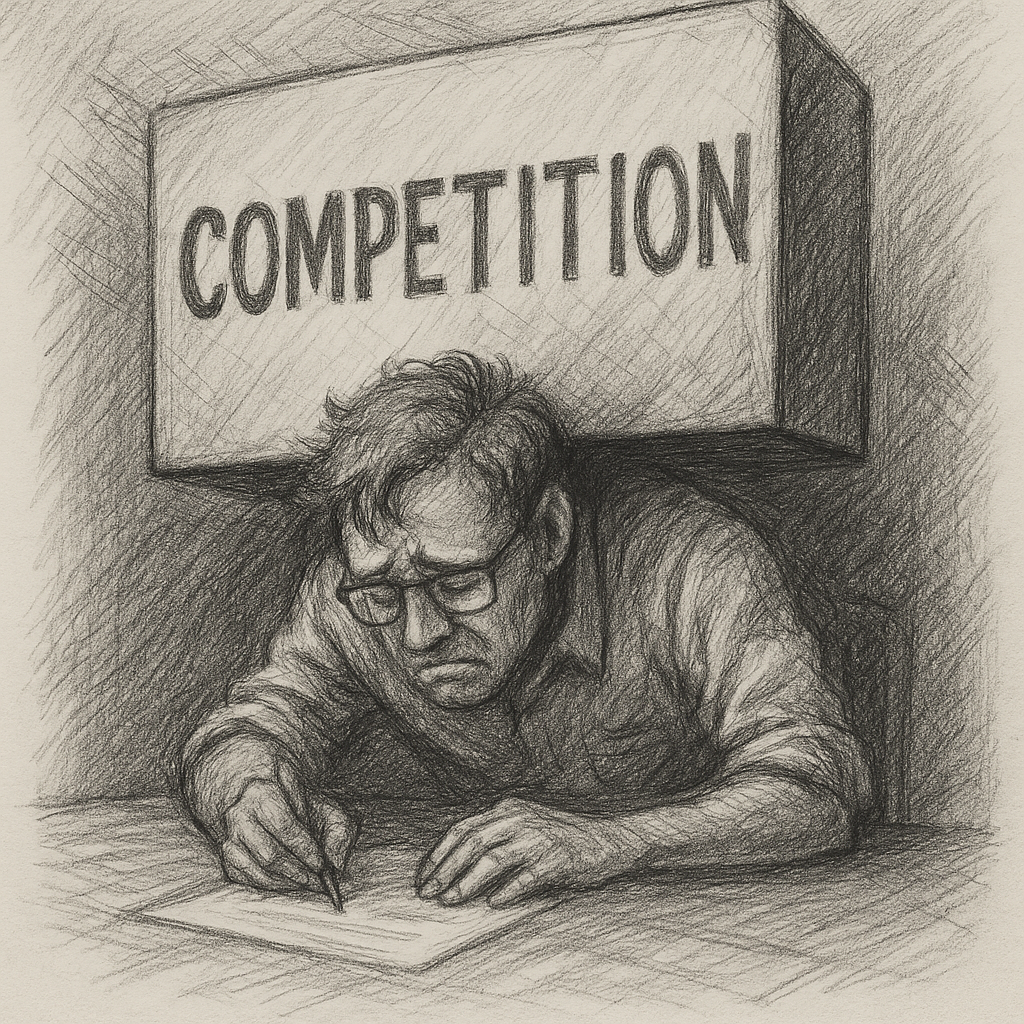
I recently sat in on a training session. The topic was innovation, and what drives innovation.
The speaker was from outside the organisation, clearly from private industry, talking to a group of people who work full-time to improve the lives and experiences of people with disability.
We can get to innovation in this context shortly, but can you guess what his number one dot point was, on his list of three dot points? What did he hold above all other things as a driver of innovation?
Competition.
The examples he gave were fine, I guess, but certainly not applicable to our workplace. I imagine the general idea is that the race to be the first to put a person on the moon drove innovation, adaptation, and space flight as a result. Maybe that’s true.
There might have been a better way, but this social drive for competition, this convincing of ourselves that we need to compete in order to achieve or innovate, creates a particular mindset. A self-supporting mindset. A self-fulfilling prophecy. We set up competition, so we competed, and we achieved the goal. As if there’s no other way.
In my work, competition isn’t even relevant.
Competition strips away the very things that matter.
Competition doesn’t make someone feel more supported or actually be more supported.
It doesn’t help them feel more heard, or more able to thrive.
It doesn’t lead to better co-design or outcomes.
If anything, it thins out the connective tissue, the trust and shared purpose.
There’s no competition involved when ADHD-me jumps down a rabbit hole trying to solve a problem. I’ll engage with everything around the problem, and plenty of things not directly related to it. I’ll do whatever I can to find a way through, to help someone achieve their goal.
And I don’t do it to win. In fact, it becomes a shared goal. We work together to achieve it. We would actively include others in our team or even outside our team to fill in the gaps that our knowledge might have. We are working together to achieve the same thing. But competition says that only one of us should achieve the goal.
Real innovation is slow. It’s relational. It’s built on trust and shared goals.
We build up. We build in.
We don’t strip away.
I sat back in my chair, shaking my head, unsure of what to make of this speaker going on about competition. I wondered what others in the room were taking from it. It worries me.
Just thinking about it, I get the lyrics of a Roger Waters song running through my head:
They like a tough game, no rules,
Some you win, some you lose,
Competition’s good for you,
To die, to be free, they’re the powers that be.
They’re like a bomb-proof Cadillac,
Air-conditioned, gold taps, backseat gun rack, platinum hubcaps.
They pick horses for courses,
They’re the market forces.
They like order, makeup, limelight, power,
Game shows, rodeos, Star Wars, TV…
They’re the powers that be.
If you see them come, you better run. You better run on home.
I like these lyrics because they show how ugly competition is or can be.
I think competition has a really big problem.
In order for one person to win, someone else must lose, or at least not win as well.
That whole notion of competition would be quite destructive in this workplace. It’s got me thinking now, more broadly, about the role that competition plays, or doesn’t play, in my life. Because it’s everywhere.
It’s in how we apply for the jobs we have.
You might be competing against one other person, or two hundred, for the one position.
And for the most part, the ones who win do so by presenting themselves as superior.
Not necessarily by being the best person for the job.
Not necessarily by performing.
If they really wanted you to compete for a job, properly compete, they’d put you all on a level playing field and give you the chance to actually perform.
To demonstrate your skills in real time, in comparison to others.
That would be competition.
But that’s not what happens.
Applying for jobs is, I would argue, more the illusion of competition. And it leads to distortion, distortion of truth, distortion of outcomes. Which, again, is a problem that arises directly from competition.
You must lose, so that I may win.
The main goal is to win the job, however I achieve it.
I’ve seen this play out in my own life, many times. I’ve known, factually, that I was the best candidate for a particular role. But I didn’t get the job, because I didn’t interview well. And I’ve seen others win those roles, only to struggle with the most basic parts of the job.
I feel confident that anyone reading this would be able to recall similar situations in their own life.
If we had been placed side by side, in an actual, level competition, I would’ve won hands down.
So no, competition doesn’t bring clarity.
It doesn’t bring the best person forward.
It doesn’t bring success.
It brings distortion.
So, let’s define innovation. Let’s define it formally.
Innovation is the process of creating or improving ideas, products, services, or ways of doing things to make them more effective, efficient, or meaningful.
I think that’s a good working definition. And when I speak of innovation in this dispatch, that’s exactly what I mean.
Going by that definition, I/we innovate almost every time we help someone with their particular situation.
We innovate together.
I ask questions. I investigate. I find ways through to help them achieve their goal, as best I can, as best we can.
More often than not, we succeed.
Let’s say someone needs to complete a web form, but the form isn’t accessible to their assistive technology. So, I help find a way around it. I might create a tool to sit in between, something they can access, that lets them do their work in an accessible space and then transfers that work back into the system that originally excluded them.
We might build a boilerplate template that simulates the form they need to use. The template is accessible. They complete their work there, and then we find a way to convert or transfer that work into the inaccessible system.
That’s innovation. Not for the sake of novelty or recognition, but because someone needs a way forward, and no one else has provided it yet.
We’re constantly thinking up new and creative ways of working around or through barriers, barriers that stop people from working productively and safely.
In some older workplaces this was never acknowledged.
Instead, we were told again, and again, how to innovate.
Sometimes, we’re told to innovate by the very same people who couldn’t find solutions to the issues we’ve been “working around” for hundreds, even thousands, of people, over decades.
That does leave a mark.
It’s a kind of resentment, I suppose. And I’m not ashamed of it.
And then, just to twist the knife, the word competition gets thrown in, as if that’s going to help.
I see people every day who are struggling, not competing, just struggling. They want what anyone wants: to do their job and go home. But they’re frustrated.
Expressed more cynically the organisation that employs them isn’t innovative, even while demanding innovation from them.
Organisations still buy software off the shelf that isn’t accessible or fit for purpose, and then expect everyone, regardless of ability, to use it and perform at the same level.
It’s tragic.
Real innovation often rests with people on the coalface. The ones trying to find a way through these rigid systems they’ve been forced to work within.
Perhaps I should’ve defined competition earlier. But I’ll define it here:
Competition is a situation in which individuals or groups are set against one another in pursuit of a limited resource, goal, or outcome, where success for one often implies failure or disadvantage for another.
Is this really what we want to do to people with a disability or an injury?
Do we want them fighting against others, to stay relevant, to meet targets, to keep their job?
I don’t think so.
Every time I’ve seen a manager push someone who uses assistive technology to perform “better,” what I see isn’t innovation. It’s suffering. It’s increased struggle. I see people disengage. I see them pushed out. I’ve seen people resign rather than compete in that way.
I do hope we’re meant to be building people up.
We’ve come from a past where people were locked away in institutions, and now we’re finally seeing them included, actively contributing to society. That’s win-win. They’re winning. We’re winning. Our own children, if born in a different time, might’ve been sent to one of those institutions, but now they can thrive and be seen.
And I’ve seen that work. I’ve seen the joy and the meaning that comes when people who were once locked out are finally let in.
If that’s not motivation enough for people to innovate, then they’re working in the wrong place.
So yes, let’s innovate.
But let’s do it for the right reasons. Let’s not compete, let’s collaborate. Let’s build each other up, instead of tearing each other down.
One of my favourite lines from Alcoholics Anonymous is the acronym Y.E.T., You’re Eligible Too.
None of us truly earned our place in life. We inherited circumstances that allowed us to be considered favourably. That was just luck. It could have gone another way. We could have been the one struggling.
So yes, you’re eligible too.
And when we build others up, we create the kind of world where, if we fall, there’ll be someone there to help lift us again.
And that’s a world worth innovating for.
If you found this reflection valuable, you can support my writing here: